When Should a Business Upgrade Its Locks vs. Rekey Them?
October 18, 2026
Two Options, One Security Goal
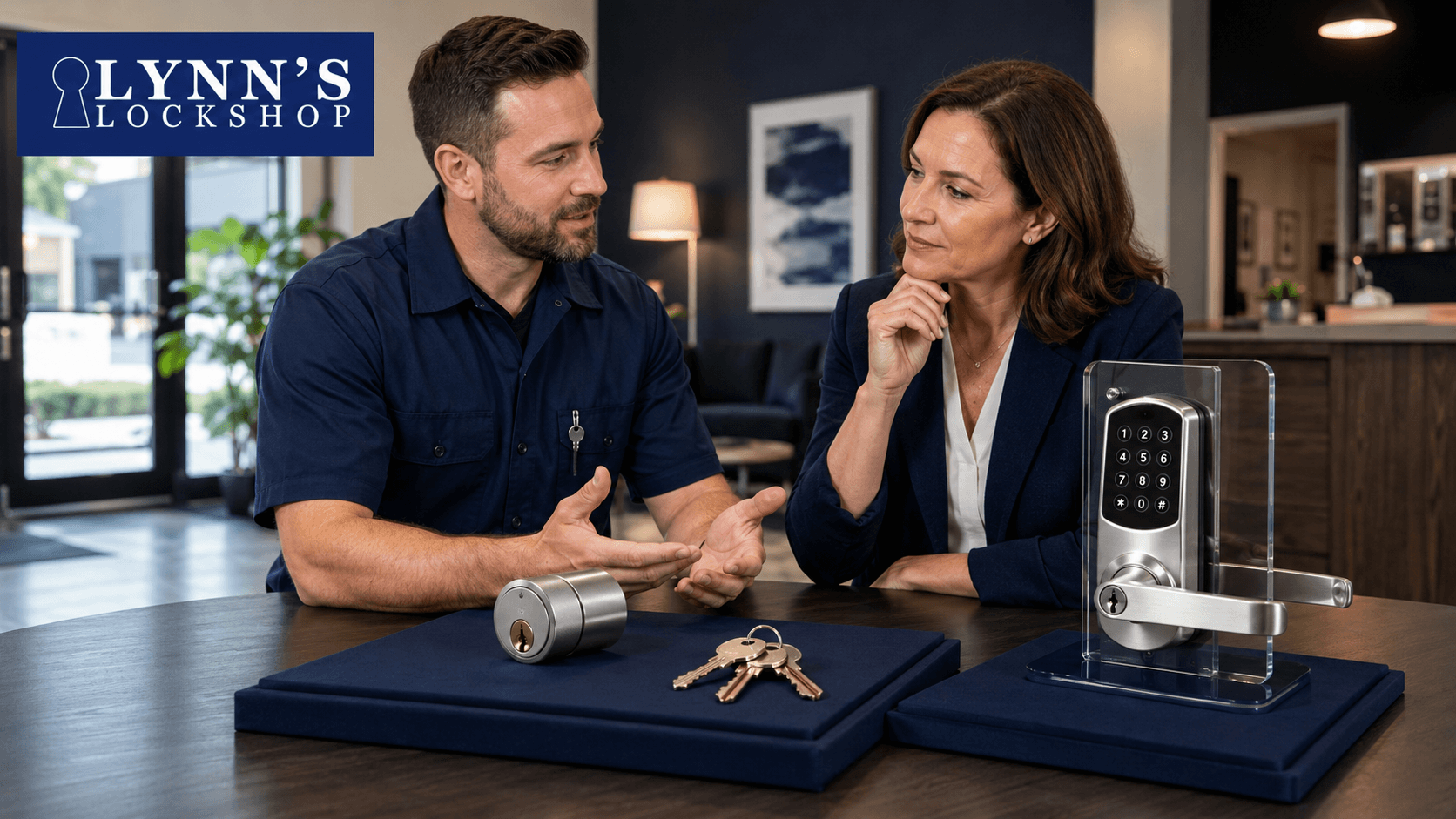
Every business eventually faces a moment that puts its locks under scrutiny. An employee leaves. A key goes missing. A break-in attempt happens nearby. Or the locks have simply been in place so long that nobody is quite sure whether they are still adequate. In Murray, Utah, businesses of all sizes go through this evaluation, and the choice they face is consistently the same: rekey the existing hardware, or upgrade to something new.
Both options protect your business. But they protect it in different ways, at different costs, and with different long-term implications. Making the right call depends on understanding what each option actually delivers and what conditions make one clearly better than the other.
What Rekeying Delivers for a Business
Rekeying changes the internal pin configuration of your existing locks so that old keys no longer work and new keys do. The hardware stays in place. For a business, rekeying is fast, minimally disruptive, and effective at solving a specific problem: eliminating access held by people who should no longer have it.
This makes rekeying the right answer for a well-defined category of situations. When an employee with key access leaves — whether voluntarily or otherwise — rekeying the affected locks immediately eliminates the risk without requiring new hardware. When a key cannot be confirmed returned, rekeying is the only way to guarantee that key no longer works. When multiple locks need to be matched to a new master key configuration, rekeying achieves that without hardware replacement.
The economics of rekeying favor businesses that have sound, appropriately graded hardware already in place. Rekeying a good lock is an efficient and cost-effective way to maintain control over who has access. Rekeying a poor lock is a temporary answer that leaves the underlying security gap in place.
What Upgrading Delivers That Rekeying Cannot
Upgrading means replacing the lock hardware itself — the cylinder, the lock body, and potentially the strike plate and associated components. It costs more than rekeying, requires more installation time, and causes more disruption to daily operations. But it delivers capabilities that rekeying simply cannot.
Higher Security Grade
If your business is currently running on builder-grade or standard residential hardware, rekeying those locks maintains the same level of security they already provide — which may not be adequate. Upgrading to ANSI Grade 1 commercial hardware brings a meaningful and tested improvement in resistance to picking, drilling, and forced entry. For businesses in Murray, Utah that have experienced a security incident or that store high-value inventory or sensitive information, this improvement is not cosmetic.
Access Control Capabilities
Traditional keyed locks, regardless of how many times they are rekeyed, cannot provide audit trails, time-restricted access, or remote management. Electronic access control systems and smart lock platforms offer all of these capabilities. For businesses with multiple employees, multiple access points, or compliance requirements that include access logging, upgrading to an electronic system is the only way to meet those needs.
Reduced Long-Term Rekeying Costs
A business that rekeys regularly — after every departure, every lost key, every access change — accumulates rekeying costs over time. Electronic access control eliminates most of these costs. When an employee leaves, their credential is deactivated in the system. No locksmith visit required. For businesses in Murray, Utah with regular staff turnover, the math often favors an upfront upgrade investment that reduces or eliminates recurring rekeying expenses.
A Side-by-Side Comparison for Business Decision-Making
The right choice between rekeying and upgrading depends on your specific circumstances. The following table compares the two options across the factors that matter most for commercial properties.
| Factor | Rekeying | Upgrading Locks |
|---|---|---|
| Cost | Lower upfront | Higher upfront, lower over time |
| Hardware condition required | Must be sound and adequate grade | Replaces regardless of condition |
| Disruption to operations | Minimal | Moderate — installation time required |
| Security grade improvement | None | Yes — choose appropriate grade |
| Audit trail capability | None | Yes — with electronic systems |
| Remote access management | None | Yes — with smart lock platforms |
| Best for | Access control after a departure | Security upgrades or system changes |
Specific Scenarios and the Right Answer for Each
The following scenarios represent the most common situations businesses in Murray, Utah face when evaluating their locks. Each points clearly toward one option or the other.
An Employee Left and May Not Have Returned Their Key
Rekey. This is the scenario rekeying was designed for. It is fast, cost-effective, and eliminates the access risk without any change to your hardware or operations. If the employee held a master key, rekey all affected locks, not just the one their key was most likely used for.
A Break-In Was Attempted on Your Premises
Upgrade. An attempted break-in typically means the current locks were tested against an attacker. Even if they held, the hardware may have sustained internal stress. More importantly, a security incident is the appropriate trigger for evaluating whether your current hardware grade is sufficient for your risk level. Rekeying does not address grade.
You Are Moving Into a New Commercial Space in Murray, Utah
Rekey at minimum, upgrade if hardware is inadequate. The priority is ensuring previous tenants no longer have access. If the hardware is in good condition and appropriately graded, rekeying achieves that efficiently. If the hardware is old, low-grade, or insufficient for your business type, upgrading during the move-in phase is far less disruptive than doing it after you are operational.
You Have Regular Employee Turnover
Upgrade to electronic access control. Recurring rekeying costs for high-turnover businesses add up quickly. An electronic system eliminates those costs while providing better access management. The upfront investment typically pays back within one to three years for businesses undergoing multiple rekeying events annually.
Frequently Asked Questions
Can I rekey my commercial locks to a master key system without replacing the hardware?
In many cases, yes. A locksmith can rekey existing locks to fit within a master key hierarchy without replacing the hardware, provided the cylinders are compatible with the desired key profile. This is a more complex rekeying service than a standard rekey and should be handled by an experienced commercial locksmith.
How do I know if my current commercial locks are the right grade for my business?
ANSI Grade 1 is the standard for commercial applications with regular daily use. If your current locks are not Grade 1, or if you are unsure of their grade, a locksmith can assess your hardware and confirm whether it is appropriate for your business type and traffic volume.
Does upgrading to a smart lock system require rewiring or major installation work?
Most smart locks designed for commercial retrofit installation do not require new wiring and fit standard door preparations. More comprehensive access control systems with card readers, electric strikes, or centralized management may require additional installation work. A pre-installation site assessment will clarify what your specific doors and infrastructure require.
What is the typical cost difference between rekeying and upgrading commercial locks in Murray, Utah?
Rekeying a commercial lock typically costs $20 to $50 per cylinder plus a service call fee. Upgrading to new commercial-grade hardware runs $150 to $500 or more per door depending on the lock type. The right comparison is total cost over several years — factoring in any future rekeying events — rather than a single-service comparison.
How often should a business schedule a full lock and security audit?
An annual security review is a reasonable baseline for most businesses. Higher-risk businesses — those handling cash, sensitive data, or high-value inventory — benefit from a review every six months or any time a significant operational change occurs, such as a renovation, a lease renewal, or a major staff transition.
Making the Right Call for Your Murray, Utah Business
Neither rekeying nor upgrading is universally the better answer — the right choice depends on your hardware condition, your security grade, your access management needs, and your budget horizon. Businesses with sound hardware and a specific access control problem should rekey. Businesses with inadequate hardware, regular turnover, or security upgrade requirements should invest in an upgrade.
Lynn's Lockshop works with businesses throughout Murray, Utah on exactly this kind of decision — providing straightforward assessments of existing hardware and honest recommendations for what will actually solve the problem. Call
(801) 699-0511 to schedule a commercial security consultation.