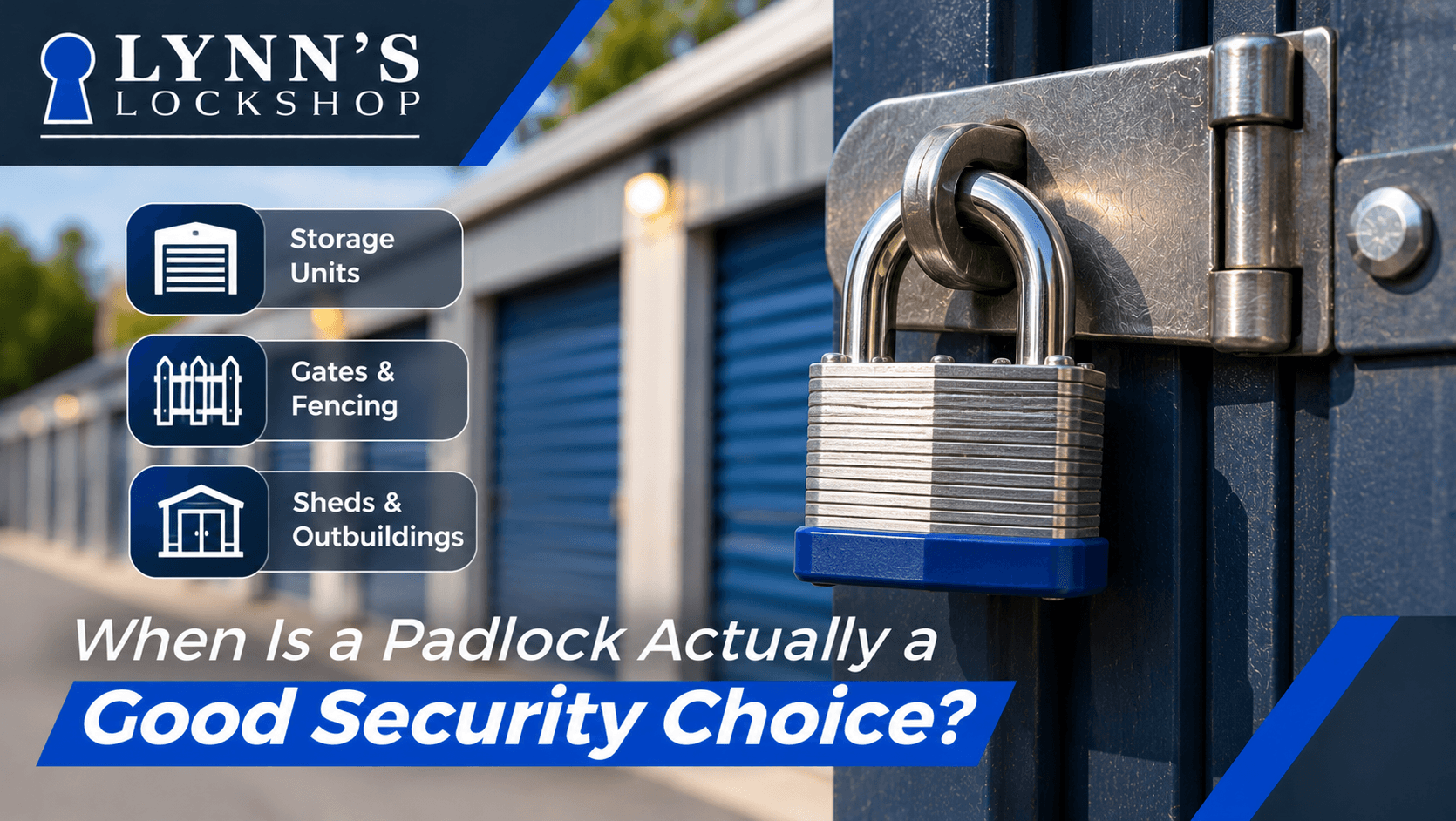
A padlock is a good security choice for securing gates, chains, hasp-fitted storage hardware, outbuildings, and temporary or portable access control — situations where a fixed lock cannot be installed. A padlock is not a good choice as the primary security on a fixed door, on a weak hasp, or in unmonitored long-term applications. The padlock's grade, shackle diameter, and the strength of the hasp it secures all determine whether it actually provides protection or just the appearance of it.
The Most Portable Lock Has More Limits Than Most People Realize
Padlocks are among the most commonly used and most frequently misapplied locks in residential and commercial settings across Murray, Utah. They appear on storage units, shed doors, gate chains, toolboxes, and job site equipment. They are portable, inexpensive, and universally recognized as a security measure. But padlocks are also frequently used in situations where they provide minimal actual protection — either because the application is wrong for a padlock, or because the padlock chosen is far below the quality level the situation requires.
Understanding when a padlock is genuinely the right tool, what specifications produce meaningful security, and where other lock types consistently outperform padlocks is what separates a padlock that secures something from one that merely suggests it.
What Makes a Padlock Vulnerable
A padlock's core vulnerability is its exposed shackle — the U-shaped metal loop that passes through the hasp or chain and is released when the lock opens. Unlike a deadbolt bolt that is protected by the door and frame surrounding it, the padlock shackle is largely exposed on two sides, creating attack vectors that do not apply to integrated or mortised lock hardware.
The most common attack against padlocks is bolt cutting — severing the shackle with bolt cutters available at any hardware store. A standard padlock with a 5/16-inch shackle can be cut in seconds with readily available tools. Shimming inserts a thin piece of metal into the shackle opening to release the locking pawl. Picking a padlock cylinder is often easier than picking a door lock because the manufacturing tolerances on lower-grade models are less precise. The hasp or chain the padlock secures is frequently weaker than the padlock itself — making the padlock's grade irrelevant if the hasp fails first.
Four Situations Where a Padlock Is the Right Security Choice
1. Securing Gates, Chains, and Temporary Barriers
Padlocks are well-suited to securing chains, cables, and gates where fixed lock hardware cannot be installed. A gate that must remain openable from both sides, a chain securing a trailer to a post, or a cable lock on outdoor equipment in Murray, Utah — these are applications where the padlock's portability and chain compatibility make it the practical choice. The key is selecting a padlock whose shackle diameter and material genuinely resist the cutting tools that could be brought to the location.
2. Storage Units and Outbuildings With Hasp Hardware
Self-storage facilities and outdoor storage buildings typically have hasp-and-staple hardware designed specifically for padlocks. For these applications, a quality padlock is the intended and appropriate security measure. The padlock's effectiveness in this context depends as much on the hasp as on the lock itself — a high-grade padlock on a lightweight stamped-metal hasp secured with short screws provides minimal protection regardless of the lock's rating.
3. Supplementary Security as a Secondary Layer
Padlocks can add a meaningful secondary layer to existing hardware in Murray, Utah properties. A padlock added to a sliding door track bar, a hasp on a cabinet door, or a chain through a gate handle supplements the primary lock with an additional mechanism an intruder must defeat. This kind of layered approach is particularly useful for commercial properties with multiple entry points of varying quality.
4. Temporary and Portable Access Control
Padlocks are appropriate for situations where security requirements are temporary or where a fixed lock installation is not feasible — a construction site with changing access needs, a temporary fence around an installation area, or seasonal storage where the lock is removed during the off-season. In these contexts, the padlock's portability and interchangeability are genuine practical advantages rather than security compromises.
How to Choose a Padlock That Provides Actual Security
Padlock quality varies dramatically across the price range. The following table compares the specifications that distinguish a padlock providing real security from one that only appears to.
| Specification | What to Look For |
|---|---|
| Shackle material | Hardened boron steel or hardened alloy — resists bolt cutting and sawing attacks |
| Shackle diameter | 3/8 inch minimum for serious use; 1/2 inch or closed-shackle for high-risk locations |
| Shackle exposure | Closed-shackle designs minimize exposed length available to bolt cutter jaws |
| Cylinder quality | Security pins for pick resistance; shrouded or protected cylinder for drill resistance |
| Body material | Solid brass or hardened steel — resists prying and impact better than pot metal or zinc alloy |
| ANSI/BHMA grade | Grade 1 for high-security applications; Grade 2 for standard commercial use |
| Anti-shim mechanism | Double-locking shackle design prevents shimming attacks on the locking pawl |
When a Padlock Is the Wrong Choice
There are specific situations where a padlock consistently fails to provide the protection it appears to offer. These are the applications to avoid regardless of the padlock's grade.
- Primary entry doors to homes or businesses: A deadbolt mortised into the door and frame is substantially more secure than any padlock and hasp combination on a door, because the deadbolt's bolt is fully protected by the surrounding hardware while the padlock's shackle is exposed.
- Any application where the hasp is weaker than the lock: A high-grade padlock on a flimsy hasp secured with short screws provides no meaningful improvement over a budget padlock. The hasp is the structural weak point that is attacked first.
- Long-term, unmonitored locations: Padlocks left in place for extended periods in unsupervised areas invite slow attacks — sustained cutting, drilling, or prying that would not be viable in a monitored or trafficked location.
- Interior applications where integrated lock options exist: Wherever a keyed cylinder lock, a cam lock, or an integrated cabinet lock can be installed, it provides better security than a padlock and hasp, because the bolt is protected inside the hardware rather than exposed on an accessible shackle.
Frequently Asked Questions About Padlock Security
What padlock brands are consistently considered high quality for serious security use?
Abloy, Medeco, Mul-T-Lock, and ABUS Granit are widely recognized for high-security padlocks with hardened shackles, security pin cylinders, and anti-shim mechanisms. Master Lock and American Lock produce reliable mid-grade padlocks with ANSI ratings appropriate for most standard commercial applications. Avoid unbranded or unrated padlocks at any price point.
Can padlocks be rekeyed to a different key?
Some padlocks with rekeyable cylinders can be serviced by a locksmith using the same pin tumbler rekeying process as door locks. However, most standard padlocks are not economically worth rekeying — the cost approaches the price of a new padlock of similar quality. High-security padlocks from manufacturers like Abloy are designed for long-term service and can be rekeyed as part of their intended operational lifecycle.
What is a closed-shackle padlock and when is it the right choice?
A closed-shackle padlock has a body that surrounds the shackle on both sides, leaving only a small portion exposed at the top. This dramatically reduces the space available for bolt cutter jaws, making cutting attacks significantly harder. Closed-shackle padlocks are recommended for any application where the padlock will be left unattended in an accessible location for extended periods.
Is a combination padlock as secure as a keyed padlock of the same grade?
At the same quality tier, keyed padlocks with security pins are generally more resistant to manipulation than combination padlocks. Combination padlocks are also vulnerable to decoding — a patient attacker can detect slight resistance changes as the correct digits are approached. Keyed padlocks are the better choice for security applications. Combination padlocks are appropriate for convenience situations where attack resistance is a secondary concern.
How do I know if the hasp I am using is strong enough for my padlock?
A hasp should be made from hardened or reinforced steel, mounted with bolts or screws long enough to reach solid structural material behind the surface, and have a staple diameter that matches or exceeds the padlock shackle size. A hasp that flexes, bends, or pulls away from its mounting under hand pressure is not adequate for any security-oriented padlock application. Replacing the hasp is often the higher-impact upgrade compared to upgrading the padlock itself.
Choose the Right Lock for the Right Application in Murray, Utah
A padlock is a genuinely good security choice when used correctly — securing gates, chains, storage hardware, and temporary access control needs where fixed lock installation is not practical. In the wrong situation, particularly as the primary security on a fixed door or mounted on a weak hasp, a padlock provides the appearance of security without the substance.
For property owners and businesses across Murray, Utah trying to determine whether a padlock is the right tool for a specific application, Lynn's Lockshop provides straightforward recommendations and professional installation. Call (801) 699-0511 for an honest assessment of your security hardware — and the difference between hardware that looks secure and hardware that actually is. [Internal link: Residential and Commercial Lock Services]