Why Are Push-to-Start Key Problems Harder to Diagnose?
July 2, 2026
The System That Was Supposed to Make Things Simpler
Push-to-start technology was designed for convenience — walk up to your car, press a button, and go. For most drivers in Murray, Utah, it works exactly that way, every day, without a second thought. Until it doesn't.
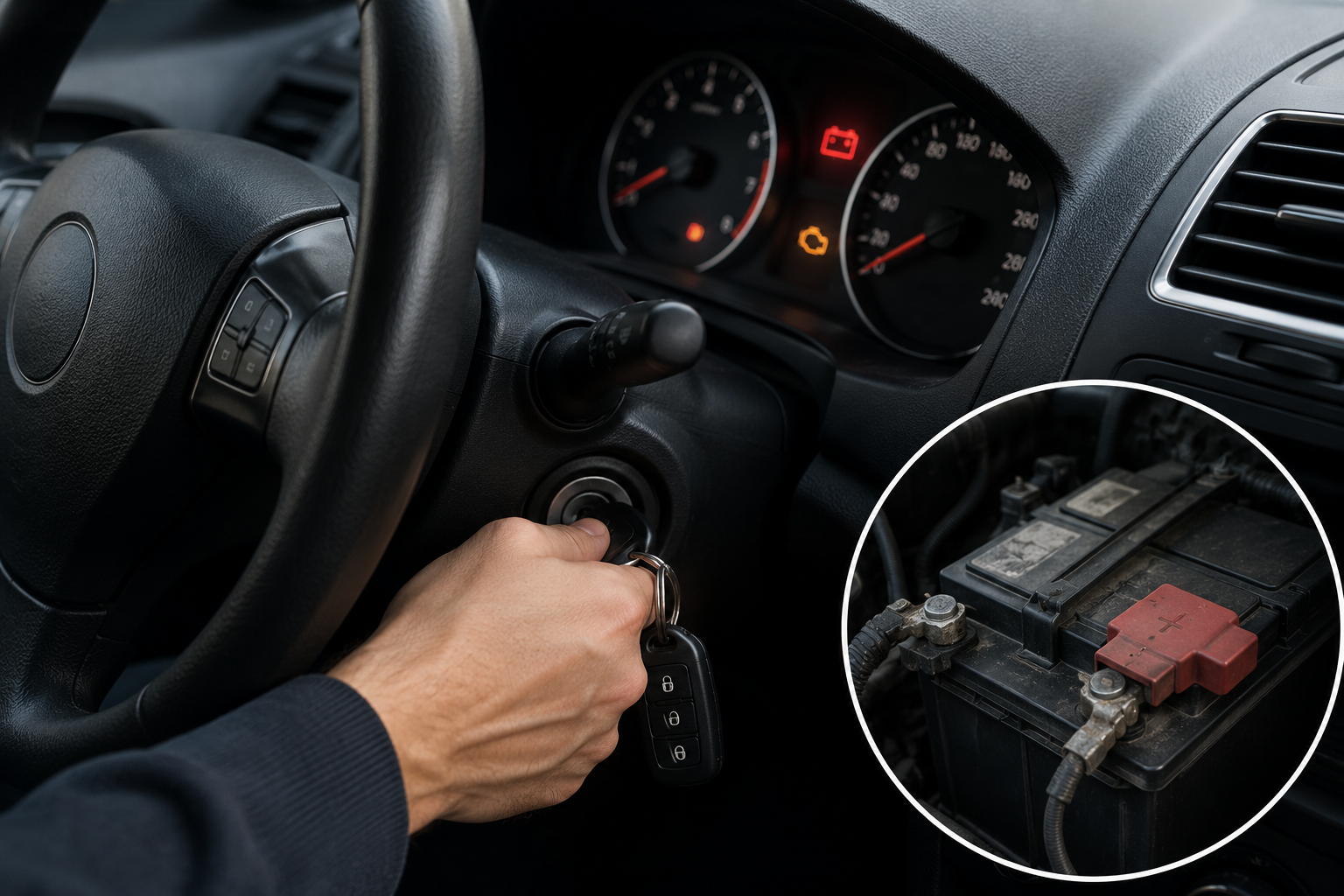
When a push-to-start system fails, it tends to fail in a way that is frustratingly opaque. The car won't start, there's no obvious explanation, and the usual tricks — checking the battery, trying a spare key — may not help. That's because diagnosing these systems requires understanding several layers of technology that are working — or not working — simultaneously.
How the System Works: The Foundation of the Diagnosis Problem
A push-to-start system is not a single component. It is a network of hardware and software elements that must all function and communicate correctly for you to start your vehicle. Here is what happens in the seconds between pressing the button and the engine turning over:
- Your key fob continuously transmits a low-frequency encrypted signal.
- Antennas embedded in the door handles, dashboard, and floor detect the signal.
- The BCM (Body Control Module) receives the signal and verifies its authenticity against stored pairing data.
- When you press the start button (with brake pedal depressed), the BCM confirms the key is present and within range.
- The BCM sends an authorization signal to the ECU (Engine Control Unit).
- The ECU allows the starter circuit to engage and the engine to crank.
A failure at any point in this chain produces the same visible result: the car does not start. That is the core of why diagnosis is so challenging.
Why Traditional Troubleshooting Falls Short
With a conventional key, the diagnostic path is relatively linear. Either the key fits and turns, or it doesn't. Either the engine cranks, or it doesn't. Push-to-start systems break this linearity entirely. The same 'car won't start' symptom can originate from any of the following sources:
- A depleted coin cell battery inside the key fob
- A damaged or cracked transponder chip inside the fob
- A malfunctioning antenna module in the door, dash, or floor
- A BCM software glitch requiring a reset or reflash
- A low car battery providing insufficient voltage to run the antenna network
- A failed brake pedal position switch preventing start authorization
- A starter relay or starter motor issue unrelated to the key system
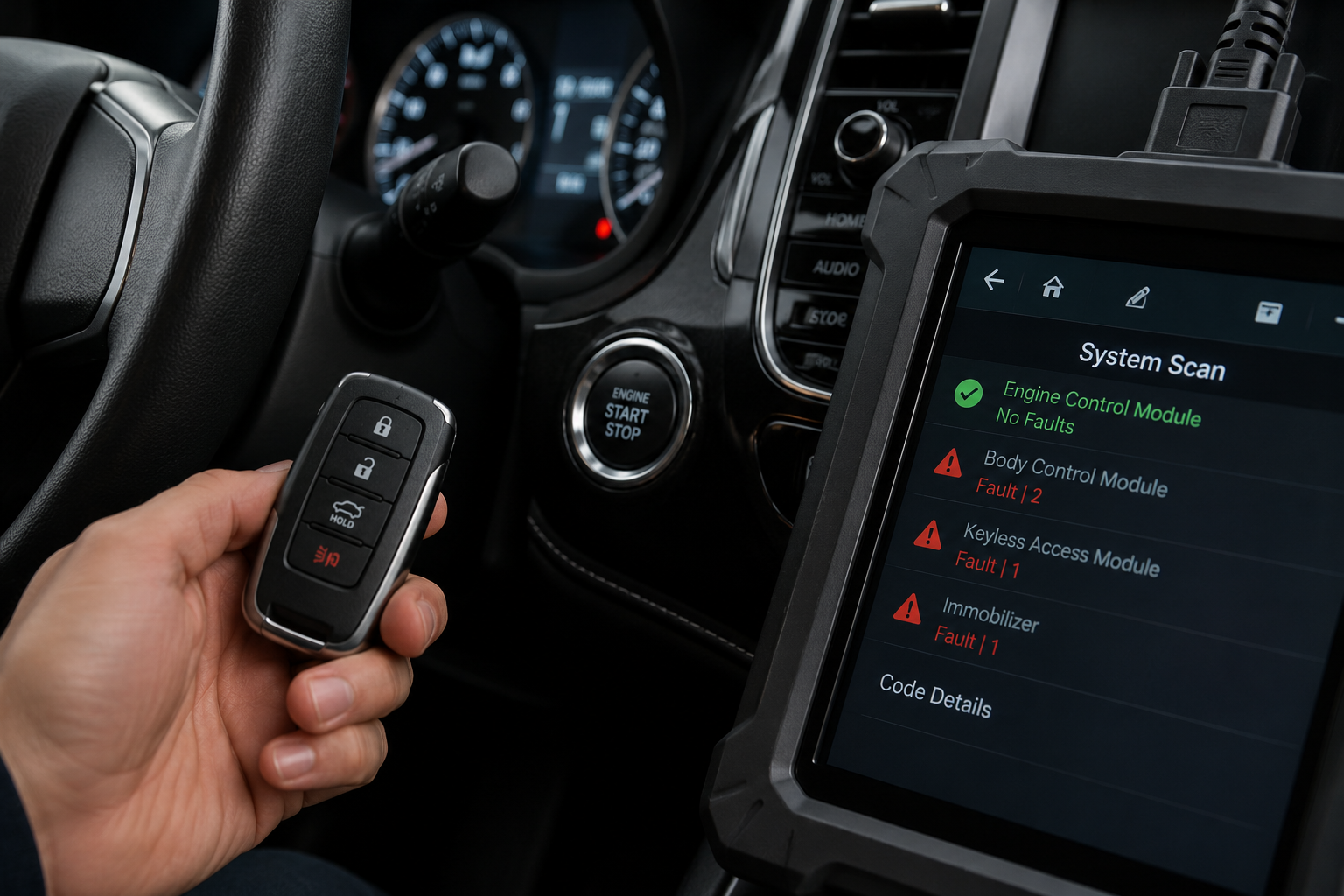
- An immobilizer fault that needs a dealer-level scan to clear
Because each of these presents the same symptom, the only way to distinguish between them is systematic diagnosis — not guessing. And systematic diagnosis requires tools that go beyond what a standard OBD-II reader provides.
Common Error Messages and What They Actually Mean
Push-to-start vehicles often display specific dashboard messages when something goes wrong. Understanding what these messages indicate — and what they don't — can prevent expensive misdiagnosis. The table below covers the most frequently reported warnings:
| Dashboard Message | What It Suggests | What Else It Could Be |
|---|---|---|
| Key Not Detected | Fob out of range or dead fob battery | Failing antenna module or low car battery |
| Key Fob Battery Low | Replace coin cell in fob | Usually accurate — replace and retest |
| Start Button Flashing | System detected key but start failed | Brake switch fault or starter relay issue |
| No Key Present | Fob not communicating with antennas | BCM communication error or damaged transponder |
| Push Brake to Start | Brake pedal not being detected | Brake switch failure, not a key problem at all |
The Role of the BCM in Making Diagnosis Harder
The Body Control Module is the system's central authority. It manages key authentication, passive entry, and start authorization. When the BCM develops a fault or a software error, the symptoms can be wide-ranging and inconsistent — the car may start sometimes and not others, or work perfectly in warm weather but fail on cold Utah mornings.
Reading BCM fault codes requires a professional-grade scan tool that communicates with manufacturer-specific protocols. The generic OBD-II scanners available at auto parts stores do not have this capability. This means that a driver or a general mechanic without the right equipment is essentially diagnosing blindly.
Intermittent Failures: The Hardest Cases
Intermittent push-to-start failures — where the system works sometimes but not others — are consistently the most difficult cases to resolve. By the time a technician examines the vehicle, it may be starting normally, leaving no active fault code to read.
Intermittent failures most commonly point to a hairline crack in the fob's transponder chip, a loose connection in the antenna wiring harness, or a BCM that is beginning to fail but has not failed completely. These require hands-on inspection and often component-level testing to identify.
Frequently Asked Questions
Is there a way to start a push-to-start car if the fob battery is completely dead?
Yes. Most push-to-start vehicles have a backup method. Hold the fob directly against the start button — there is usually a hidden inductive reader in the button housing that can read the fob's signal even without battery power. Check your owner's manual for the exact procedure on your make and model.
Will a spare key fob have the same problem as the original?
If the issue is with the vehicle's antenna module or BCM, a spare fob will likely have the same problem. If the issue is with the original fob itself — a dead battery or cracked chip — the spare should work normally.
Can extreme cold temperatures in Utah affect push-to-start reliability?
Yes. Cold temperatures can affect the fob's battery output, cause door seals to compress differently (affecting antenna reception), and in rare cases trigger BCM calibration issues. If your push-to-start system is unreliable in cold weather specifically, temperature sensitivity is worth investigating.
How long does it take to reprogram a push-to-start key fob?
Programming time varies by vehicle make and model. A straightforward fob reprogramming by a qualified locksmith typically takes 20 to 45 minutes. Vehicles requiring dealer-level tools or more complex reinitialization may take longer.
My dealership quoted a high price to fix my push-to-start issue — can a locksmith do it for less?
In many cases, yes. A qualified automotive locksmith can handle fob programming, transponder replacement, and many BCM-adjacent issues at a lower cost than a dealership. The exception is when the fault is a complex factory software issue that genuinely requires OEM equipment.
Getting a Real Answer in Murray, Utah
Push-to-start problems are not simple, and the temptation to replace parts sequentially until something works is an expensive path to an answer that a proper diagnosis would have provided upfront. In the Murray, Utah area, where these vehicles are common, having a trusted automotive locksmith who understands these systems is worth a great deal.
Lynn's Lockshop works with smart key and push-to-start systems across a wide range of makes and models. If your system is misbehaving and you want a diagnosis before spending money on guesses, give them a call at
(801) 699-0511.